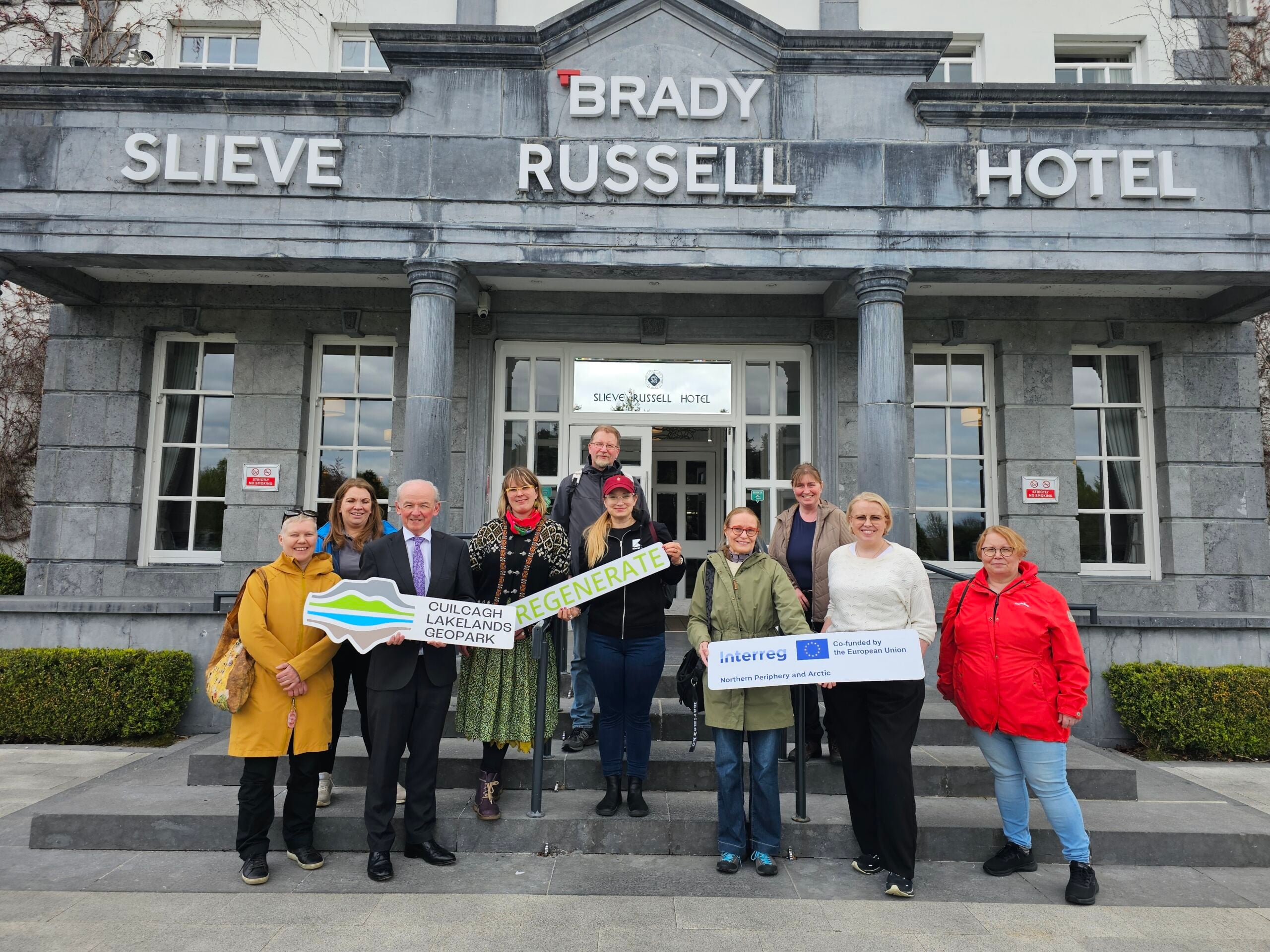
In April 2026, a delegation from Karelia University of Applied Sciences, together with regional stakeholders, undertook a Stakeholder Learning Journey to Cavan, Ireland, as part of the REGENERATE project. The visit took place in the Cuilcagh Lakelands UNESCO Global Geopark, a distinctive cross-border destination jointly managed by Ireland and Northern Ireland.
The purpose of the journey went beyond traditional benchmarking. Rather than simply comparing practices, the focus was on meaningful, in-depth learning. The delegation aimed to explore how regenerative tourism is put into practice by local businesses, communities, and networks, and to understand how effective collaboration is achieved across administrative and national boundaries.
Regeneration Starts with Relationships
The journey began with an early departure from Joensuu and arrival in Dublin, followed by a coach transfer to Cavan. We were fortunate to have Ann as our driver throughout our time in Ireland. She provided a truly memorable start to our learning journey. Rather than simply transporting us to our destination, Ann enriched the experience by sharing engaging stories, insights, and interesting facts about the landscapes we travelled through. She also showed a genuine interest in us and our culture. This offered an important reminder: in regenerative tourism, the visitor experience begins long before reaching the destination itself.
Our collaboration with project partners officially began over lunch at the Slieve Russell Hotel. This first shared activity set the tone for the entire week. The hotel not only hosted our accommodation but also plays an active role within the Geopark network. Discussions with Tony Walker, General Manager of the hotel and Chair of the Geopark Regional Tourism Business Network, illustrated how hospitality businesses can serve as key enablers of regenerative development. The hotel integrates regenerative principles into its daily operations and actively contributes to regional cooperation.
Walker emphasized the importance of employing local people and making use of local knowledge, skills, and materials whenever possible. These practices strengthen the local economy, reinforce community identity, and support the long-term sustainability of the destination.
Experiencing the Landscape Responsibly
We explored the region through a series of site visits, including Cavan Adventure Centre, the Cuilcagh Boardwalk Trail, Marble Arch Caves, Erne Water Taxi, Boatyard Distillery, Trivia House, and Corralea Activity Centre.
At Cavan Adventure Centre, we joined a guided boat trip across Lough Oughter, where we observed cattle grazing freely along the shoreline and took glimpses of the historic Clough Oughter Castle Island. The experience illustrated how nature-based tourism can operate in harmony with the surrounding ecosystem while offering engaging visitor experiences.
This perspective was reinforced during our walk along the Cuilcagh Boardwalk Trail. The trail serves as a strong example of regenerative infrastructure: the carefully designed boardwalk protects fragile blanket bogs and peatland landscapes while enabling visitor access and learning. We also received valuable insights into the conservation work carried out by the Geopark, as well as the role of the trail as the region’s most popular attraction, offering a distinctive and educational visitor experience.
Similarly, our visit to Marble Arch Caves demonstrated how guided interpretation can transform a natural site into an immersive learning environment. The focus on geology, hydrology, and conservation enriches the visitor experience, even though we did not have the opportunity to take the boat tour inside the caves.
Our journey with Erne Water Taxi further highlighted how tourism services can support low-impact mobility while strengthening connections between lakeside communities. Barry Flanagan, owner and operator of Erne Water Taxi, shared not only insights into his business but also a wealth of fascinating local stories he has gathered over the years. He demonstrated how storytelling is a central and highly impactful element of regenerative tourism.
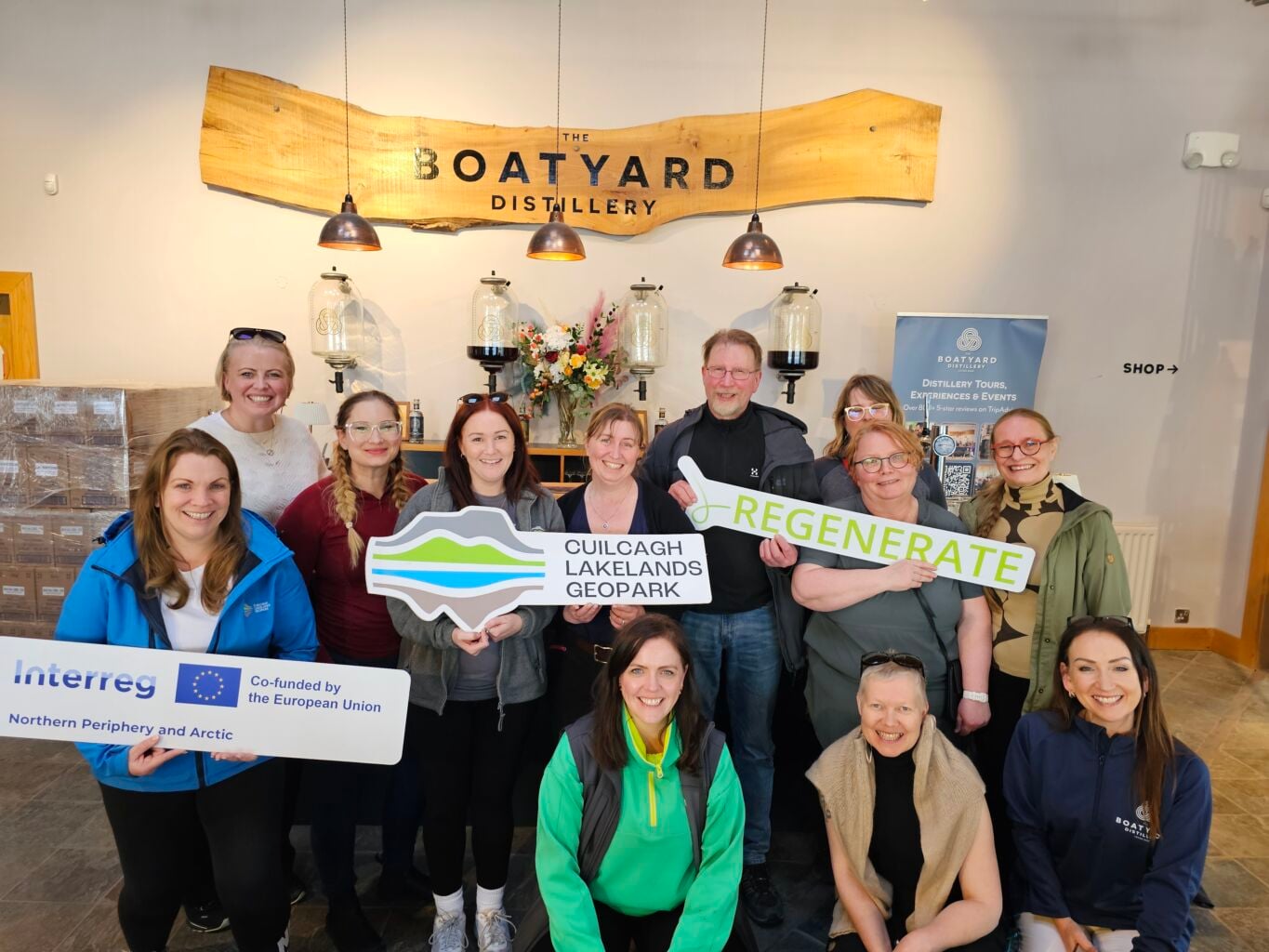
At Boatyard Distillery, we observed how regenerative principles can be integrated into business operations. These included the reuse of production by-products, local sourcing of ingredients, and a strong emphasis on storytelling and circular thinking. The visit clearly demonstrated that even production-oriented businesses can actively contribute to regenerative tourism systems.
Local Businesses, Shared Values
Throughout the journey, we were hosted by small, locally rooted businesses such as Arch House B&B, The Keepers Arms, Boatyard Distillery, and Tully Mill. Despite their different profiles, these businesses were united by a shared commitment to their community and a genuine desire to offer visitors authentic, hands-on experiences. They emphasized their use of local producers, their employment of local staff, and their active role as contributors to the vitality of the community.
The final stages of our learning journey included visits to Trivia House and the Corralea Activity Centre. Trivia House serves as an essential hub for the region, for example by supporting local residents during storm seasons through the provision of electricity and shower facilities. Our discussions there further highlighted the importance of networks, which were seen as a key driver of resilience and success among all participants.
Corralea Activity Centre, a family-run retreat, offers eco-friendly accommodation and a range of outdoor activities. Our visit combined both learning and relaxation, as the hosts shared their experiences of running a business in a location that is not easily accessible by public transport, a challenge that closely mirrors the situation in North Karelia. As a memorable highlight, we were invited to experience a lakeside sauna, which gave us a genuine sense of familiarity and connection to home.
Our final stop was Shannon Pot, an oval-shaped, aquifer-fed pool traditionally regarded as the source of the River Shannon, Ireland’s longest river. It provided a fitting and symbolic conclusion to our journey: regeneration always begins at the source, whether in natural ecosystems or in tourism systems.
Cross-Border Collaboration: The Geopark as a Living Network
One of the most distinctive features of the Cuilcagh Lakelands UNESCO Global Geopark is its cross-border cooperation model, which brings together partners from both Ireland and Northern Ireland. This unique approach was a recurring theme throughout our discussions and became particularly tangible during the stakeholder dinner at Tully Mill, where actors from both sides of the border gathered to exchange experiences and insights with the entire learning journey group.
Rather than operating as competing destinations, the Geopark is managed as a shared territory. Tourism, conservation, education, and community development are aligned through common values, joint governance structures, and a strong commitment to long-term sustainability. This collaborative model is embedded in the Geopark’s cross-border governance and stakeholder networks, which actively promote knowledge sharing and coordinated action.
As a result, regenerative tourism is able to evolve beyond traditional growth metrics. Instead of focusing on increasing visitor numbers, the Geopark demonstrates how deeper cooperation, community engagement, and the quality of impact can drive meaningful and lasting development.
Key Takeaways for Regenerative Tourism Development
The learning journey to Cavan demonstrated clearly that regenerative tourism is not a single product or fixed method. Rather, it is a way of thinking and working that is:
- Network-based: built on trust and long-term collaboration between businesses, communities, and public actors
- Place-led: deeply rooted in local landscapes, tangible and intangible cultural heritage, narratives, and ecological realities
- Inherently cross-border: transcending administrative boundaries in favour of interconnected, living systems
- Relational: valuing encounters, conversations, and shared meals just as much as sites and activities
A central element of our experience was meeting the local ambassadors, individuals who possess not only deep knowledge of the region but also the ability to illustrate how the local network truly functions in practice. We learned that Cavan benefits from several such dedicated individuals, and we had the great privilege of being guided by some of them during our journey.
These ambassadors made our experience both meaningful and memorable. More importantly, they demonstrated the vital role that people play in bringing regenerative tourism to life. Their work strongly inspired us and underlined the importance of identifying and empowering similar ambassadors in our own region. Individuals who can help showcase Karelia as a living example of regenerative tourism in action.
For Karelia University of Applied Sciences and the REGENERATE project, this journey provided concrete and inspiring examples of how regenerative tourism can act as a catalyst for regional resilience and renewal. The insights gained extend far beyond Ireland, offering valuable lessons for future development work.
In general, the discussions held at each destination revealed that the understanding of regenerative tourism in Ireland differs from what we are accustomed to here in Finland. In Ireland, the emphasis is clearly on social responsibility and impact: the focus was on the well-being of local communities and the promotion of employment.
Ultimately, learning journeys like this remind us that there is strength in collaboration. By working together; across sectors, regions, and borders, we can create more meaningful, resilient, and regenerative tourism systems.
A special thank you goes to Karan McLernon, our REGENERATE project partner, for thoughtfully organizing this enriching learning journey.
Authors:
Tarja Kupiainen, principal lecturer, Karelia UAS
Riikka Räsänen, lecturer & project specialist, Karelia UAS