
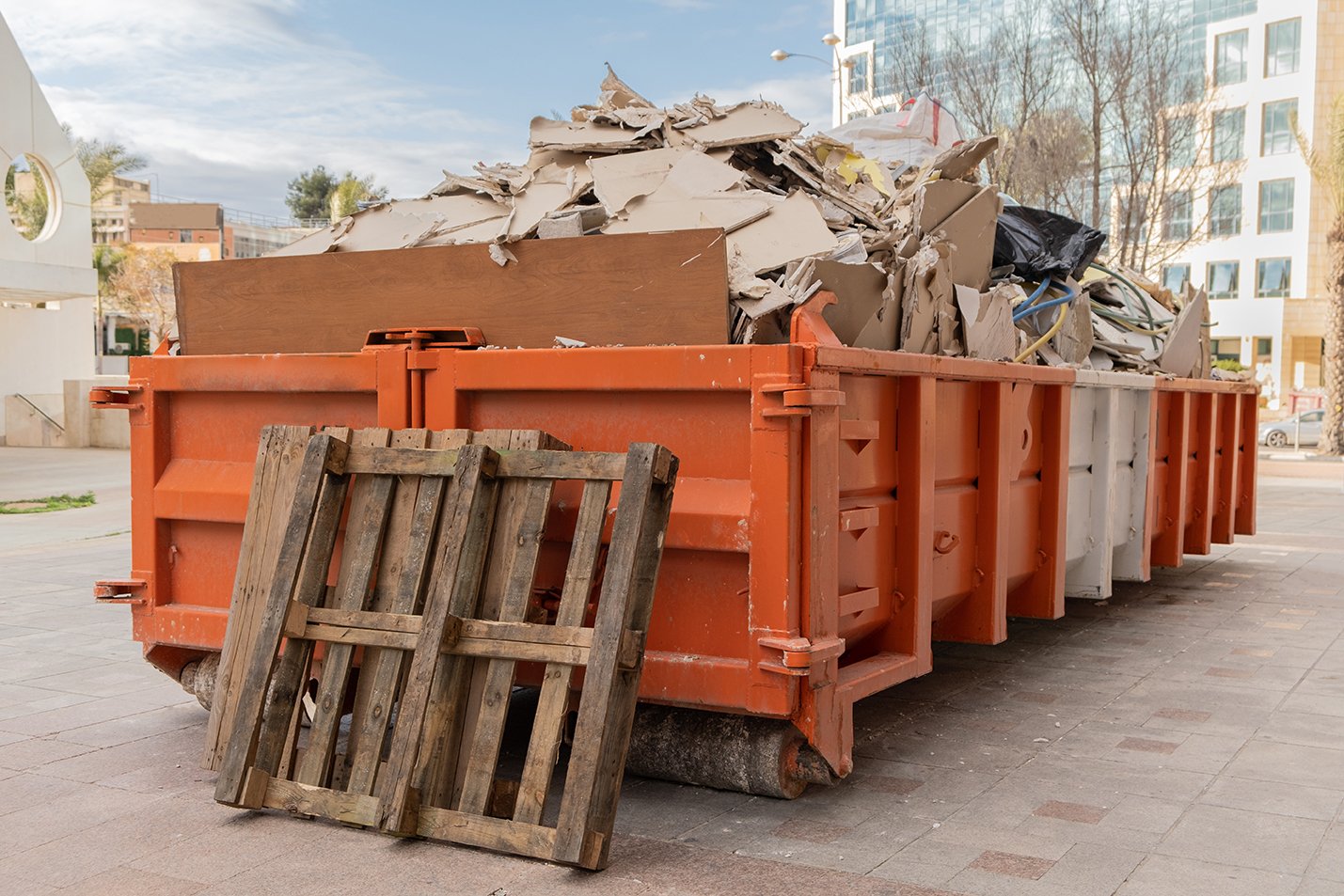
Buildings are globally responsible for about 40% carbon emissions, 50% of all extracted materials, 33% of water consumption and 35% of waste generated (World Green Building Council, 2022). In the construction sector, only a small share of building materials is typically returned to circulation. Most material fractions end up as waste after demolition, even though buildings across Europe hold huge circularity potential. A new Joint Research Centre (JRC) study estimates up to 83% potential for recycling and reuse of construction & demolition waste (Cristóbal-García et al. 2024). Our buildings contain immense but largely untapped circularity potential.
The Aurora Interreg–funded project EU-MAT: Effective Urban Material Mining in Cities focuses on promoting circular construction in northern cities, where long distances, sparse populations, and logistical challenges hinder effective material re-use. In the project, we address these challenges by developing material mining methods that can accurately assess the quantity and quality of re-usable materials from demolitions. By leveraging material flow analysis, spatial modelling and machine learning methods, innovative product development possibilities for recycled materials, and cross‑border expertise between participating countries, the partnership aims to develop methods and solutions adaptable especially to northern sparsely populated cities. Karelia University of Applied Sciences (Finland) is the project’s lead partner, working in collaboration with project partners Aalto University (Finland), RISE Research Institutes of Sweden, and the Arctic University of Norway (UiT).
Achieving Circularity Goals Requires New Solutions
Buildings are responsible for around 40% of global carbon emissions (World Green Building Council, 2022). Circular construction solutions play a significant role in reducing these emissions. The EU aims to reduce emissions in the building sector, among others, by setting new requirements for the carbon footprint of building materials as well as resource and energy efficiency (European Commission, 2021). Finland, Sweden, and Norway, the project’s partner countries, all have national goals for promoting circular economy and reducing emissions. In all these countries, reducing emissions from construction is a key factor for achieving climate targets.
Wide-scale implementation of circular solutions requires both research and development, as well as testing, piloting and embedding of innovative operational models in practice. The EU-MAT project develops a comprehensive methodology aimed at enabling building materials to stay longer in circulation. The method allows precise assessment of the amount and quality of reusable materials in buildings being demolished, supports efficient reuse and processing of materials, and provides a GIS-based tool for optimising transportation, in line with material quantity, quality, and distances.
Towards More Effective Material Utilisation and Smart Logistics
A key part of the methodology is generating accurate information about the materials contained in buildings scheduled for demolition. This way, it is possible to assess, already during demolition planning, how much materials from a demolition site can be reused. In addition to the volume of various material fractions in a building, the condition and quality of the materials can also be assessed to evaluate reuse potential.
The second core component of the methodology concerns transporting materials from demolition sites either directly to reuse locations or to processing facilities. Long transport distances increase costs and emissions, making local reuse of recovered construction materials beneficial both environmentally and economically. The EU-MAT project aims to address this challenge by developing a GIS-based transport optimization method that considers the quantity and quality of materials to be transported, as well as their demand at reuse sites and processing companies. The goal is to create a tool that ensures materials can be reused efficiently and at the right time.
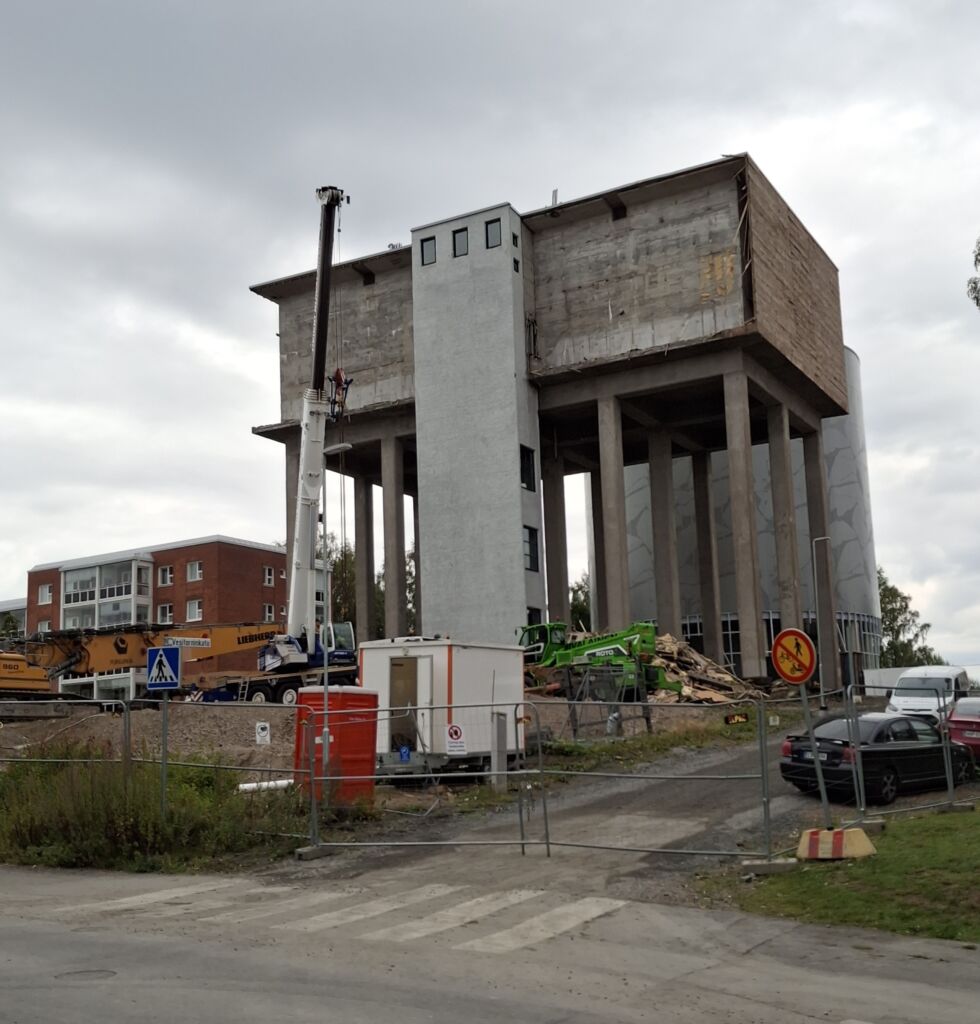
Photo: Demolition of the water tower in City of Joensuu’s Niinivaara district began around the same time as the start of EU-MAT project. Photo: Jouni Luoma
Project Collaboration in Finland, Sweden, and Norway
Cross-border cooperation is central to the project, because the circular economy challenges of northern cities in Finland, Sweden, and Norway are almost similar, and solutions developed together benefits all partners. Each project partner contributes their expertise, making it possible to develop a methodology that is both comprehensive and versatile. The partners’ geographic location also supports the project’s aims, as Norwegian and Swedish partners enable data collection and pilot testing in collaboration with the municipalities of Skellefteå and Sortland.
The City of Joensuu in Finland, is also a key collaborator, serving as a case study for developing and testing the material transport optimization model. Real-time data is collected from Joensuu’s demolition sites to improve the accuracy of methods used to assess the quantity and quality of materials in buildings being demolished. In addition, cooperation with municipalities and companies across participating countries is essential for the project’s success, as practical feedback from partners helps refine developed solutions to be more functional and scalable. This in turn promotes broader adoption and mainstreaming of the circular solutions.
Students, Experts, and Companies Engaged in Product Development
Buildings are hybrids, they consist of many different materials and construction products. For efficient material utilisation, it is important to develop new construction products that combine several types of recycled materials. In addition to using recycled materials, future building products must consider ease of disassembly and reuse already at product development phase.
In the EU-MAT project, new ideas and solutions for hybrid materials product development are explored together with students, experts, and companies. Karelia University of Applied Sciences, Aalto University, RISE Research Institutes of Sweden, and the Arctic University of Norway will jointly organise an intensive course where students have the possibility to design circular construction products that utilise multiple demolition materials within a single product. The goal is not only to create ideas for new, marketable products aligned with circular principles, but rather to encourage students, future experts, to creatively and innovatively shift approach in future of construction from linear to a circular economy perspective. Student ideas will be incorporated into RISE partner’s product development activities and collaboration with local companies.
Cost Savings and Stronger Growth Through Circular Economy Pathways
The reuse potential of construction and demolition waste is very high. To fully harness this potential, innovative circular methods and practices such as those being developed in the EU-MAT project are needed. Utilising the circular economy potential of buildings not only reduces the environmental impact of construction but also offers significant economic opportunities, such as savings in material costs and the creation of new business models. In addition, circular solutions create opportunities for logistics and construction services, thereby supporting not only environmental sustainability, but also regional employment and economic growth, and resilient operating models.
Authors:
Venla Heiskanen, project expert, Karelia University of Applied Sciences
Jouni Luoma, project manager, Karelia University of Applied Sciences
Daisy Silvennoinen, project coordinator, Karelia University of Applied Sciences
References:
Cristóbal-García, J., Caro, D., Foster, G., Pristerà, G., Gallo, F. & Tonini, D. (2024). Techno-economic and environmental assessment of construction and demolition waste management in the European Union. European Commission I Joint Research Centre Technical Report. https://circulareconomy.europa.eu/platform/en/knowledge/new-report-confirms-importance-circularity-construction-reach-climate-goals (Assessed 19.2.2026).
European Commission (2021). ‘Fit for 55’: delivering the EU’s 2030 Climate Target on the way to climate neutrality. https://eur-lex.europa.eu/legal-content/EN/TXT/?uri=CELEX:52021DC0550 (Assessed 20.2.2026).
World Green Building Council (2022). EU Policy Whole Life Carbon Roadmap. May 2022. https://viewer.ipaper.io/worldgbc/eu-roadmap/ (Assessed 19.2.2026).

