
Why Arctic energy communities are challenging to design
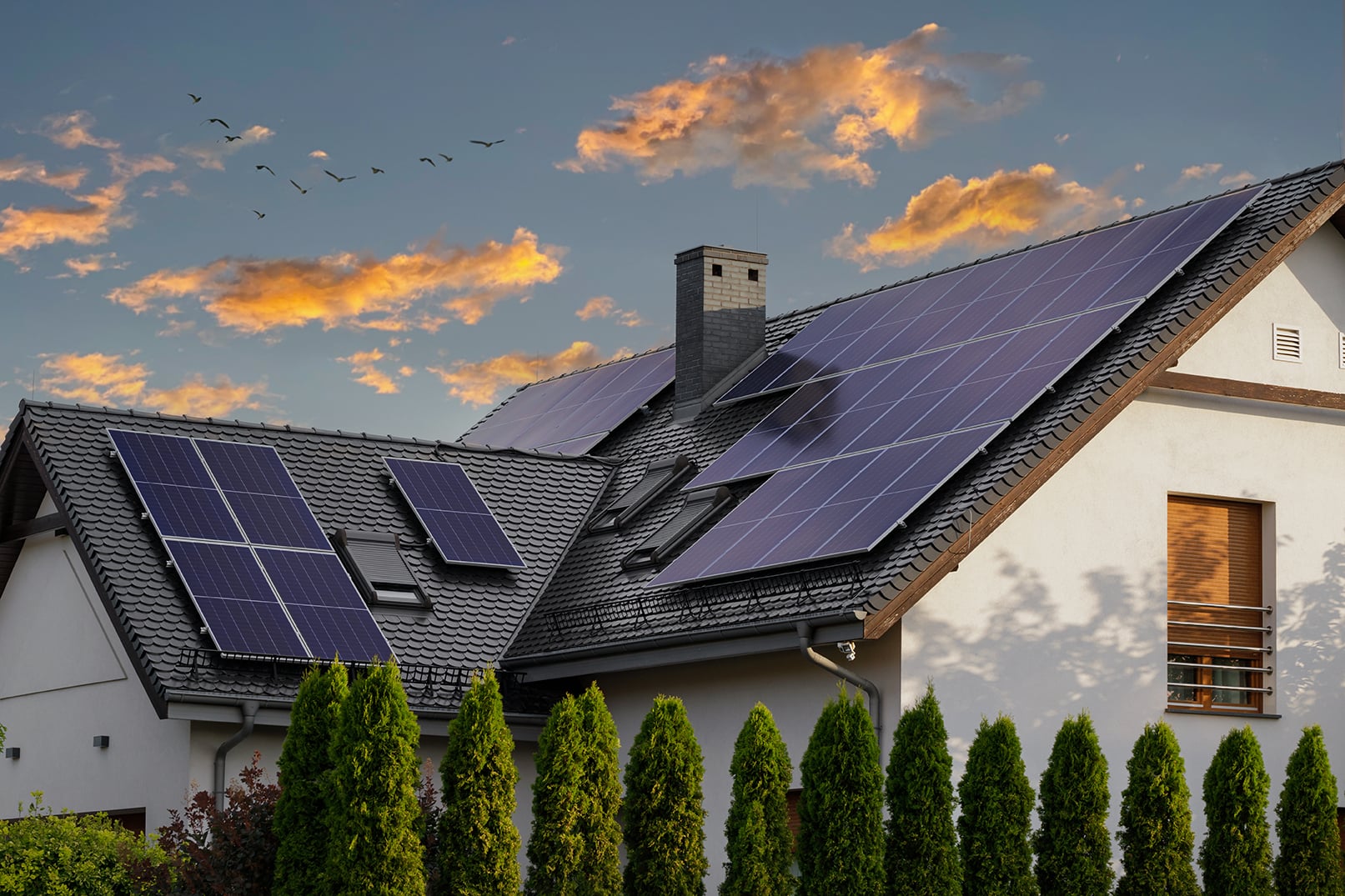
Designing resilient energy communities in the Arctic is not straightforward. Long distances, cold winters, strong seasonal variation in solar production and high heating demand shape how energy is used. These factors interact in ways that are difficult to predict without proper tools. At the same time, distributed generation, storage and smarter energy management are becoming essential parts of the green transition. Understanding how real buildings, users and technologies behave together over time is critical, and this is where simulations play an important role.
In the SEEC (Sustainable and Energy-Efficient Energy Communities) project, simulations are used to test and refine ideas before moving to physical implementation. The aim is not to simulate for its own sake, but to understand which community models actually work in northern conditions. Climate, consumption patterns and electricity markets here differ from many other European regions, and solutions must reflect that reality.
Using simulations to understand community energy dynamics
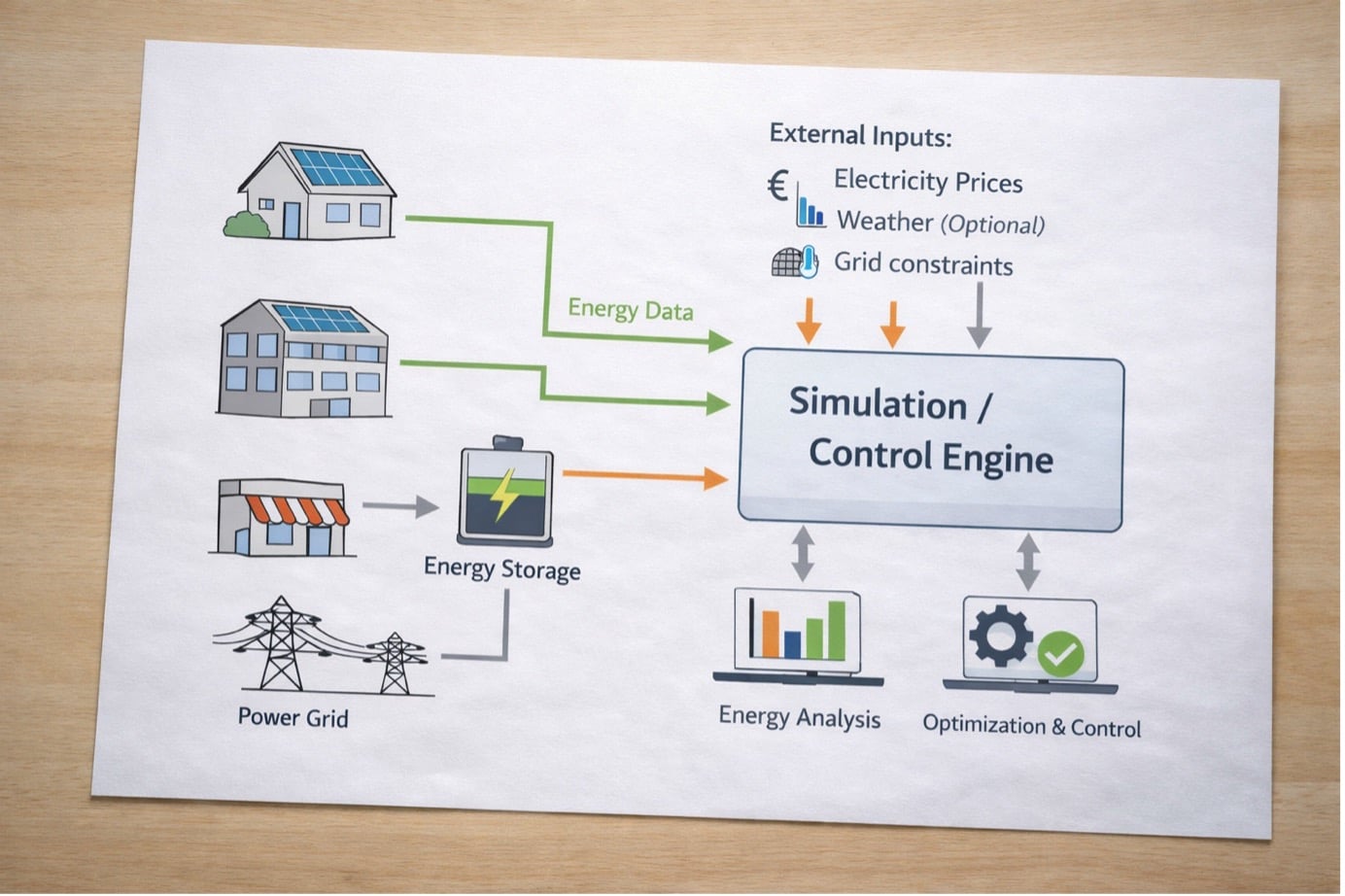
Simulations provide a structured way to explore questions that would otherwise require expensive and time-consuming field trials. We can examine how different building types respond to changing electricity prices, how solar production behaves across seasons, how storage supports the wider community and how different energy-sharing principles affect costs and fairness. Most importantly, simulations make the interactions visible. One building’s behaviour influences another. Shared storage affects peak loads. Weather conditions and price volatility propagate through the whole system. Seeing these dynamics clearly changes how we design solutions.
From abstract models to realistic community scenarios
In practice, this means building digital versions of real community structures. For example, we can model a small northern community consisting of detached houses with electric heating, one apartment building and a shared battery. Using real consumption profiles and historical price data, we can simulate a winter week with temperatures below minus 20 degrees. The model shows how peak loads develop in the evening, how the shared battery reduces grid dependency and how different energy-sharing rules change the cost distribution between participants. Running this same scenario with modified storage capacity or altered control logic immediately reveals whether the system becomes more stable, more affordable or simply more complex without added value.
A key strength of simulation-based development is the ability to model complexity in a controlled way. Real communities include detached houses, apartment buildings, holiday cottages and small businesses, each with distinct consumption patterns. In a simulated environment, these profiles can be combined and stressed under different scenarios: extreme cold periods, low renewable output, rapid price increases or new demand response strategies. Energy-sharing rules can be adjusted and compared until a technically and socially balanced configuration is found.
Scaling simulations with virtual community actors
We also work with virtual energy community actors. These are configurable digital representations of households or other participants that allow us to scale the simulated community beyond the size of a small pilot. By adding virtual actors, we can analyse how the system behaves as participation grows. This helps us understand scalability and systemic stress without physically building a large network.
These virtual actors can also be linked to real hardware in laboratory environments. In that case, physical systems operate within a simulated larger community, allowing us to observe how real devices perform under more complex, scaled-up conditions. The composition and behaviour of these actors can be modified, enabling us to test different community structures and participation patterns. SEEC plans to use this approach extensively as part of its laboratory-based development work.
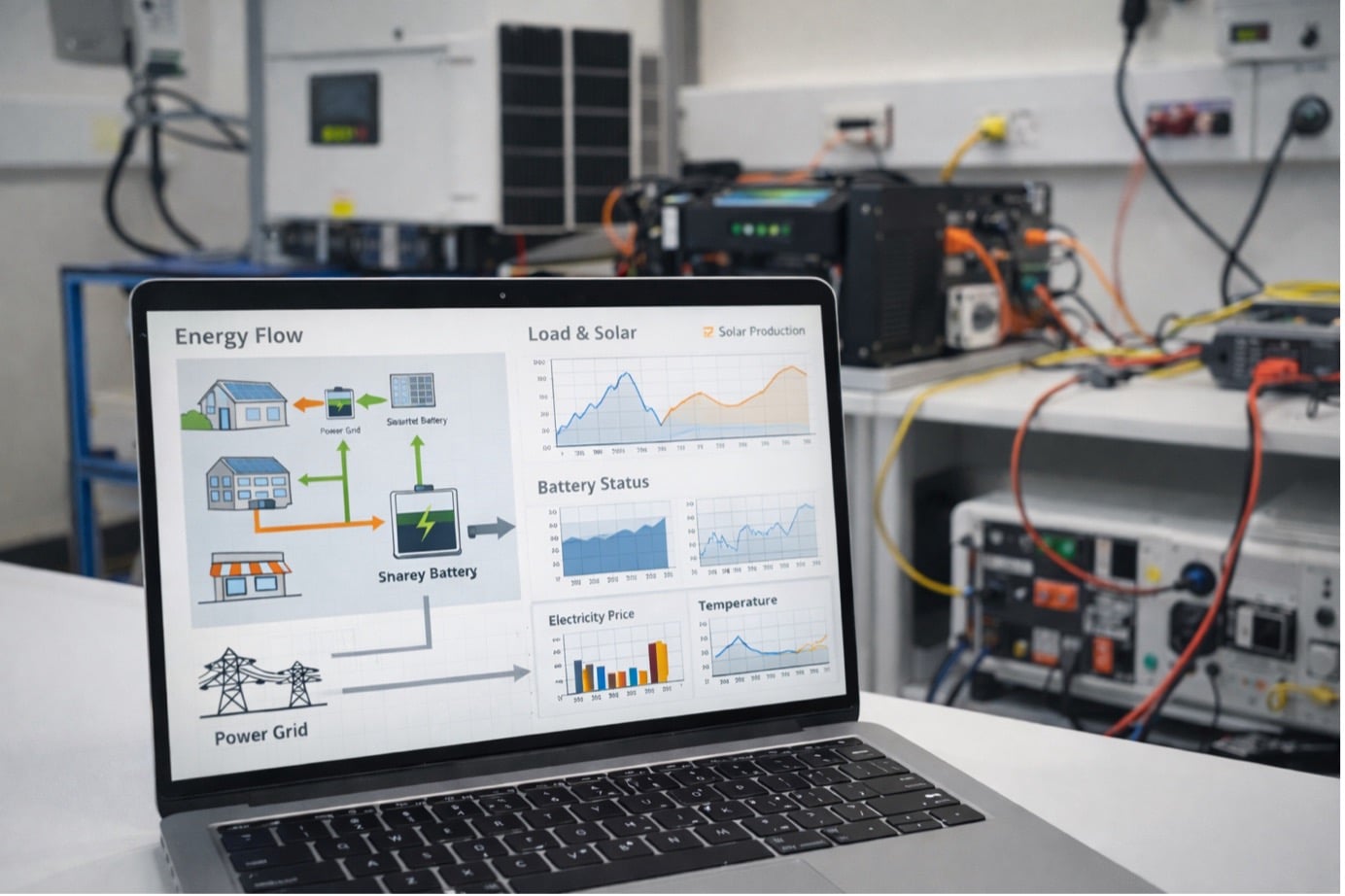
(AI-generated visualisation for the SEEC project / OpenAI)
Energy storage is another area where simulations are particularly useful. Batteries, thermal storage and vehicle-to-home concepts behave differently depending on climate, load structure and price signals. In northern regions, heating dominates energy use for much of the year, so the interaction between storage, heating systems and renewable production must be carefully analysed. Simulations allow us to estimate how much storage is actually needed, how it should be controlled and how it contributes to resilience and self-sufficiency during peak demand or limited generation.
Preparing future energy communities
Within SEEC, simulations form a bridge between theoretical design and real-world pilots. Before investing in infrastructure, building microgrids or launching cross-border demonstrations, ideas can be validated digitally. This reduces uncertainty, improves technical design and supports more informed decisions. It also creates a shared analytical framework for partners in Finland, Sweden and Norway. Even though local conditions differ, we can use common modelling approaches to compare results and learn from each other.
Simulations are not an alternative to real pilots but a necessary preparation for them. They help ensure that future energy communities, whether grid-connected or off-grid, are technically robust, economically sensible and adapted to local realities. Digital experimentation does not replace physical infrastructure, but it significantly improves the chances that the systems we eventually build will perform as intended.
Authors:
Ville Kuittinen, Senior Project Manager, Karelia University of Applied Sciences
Antti Niemelä, Senior Specialist, Lapland University of Applied Sciences