

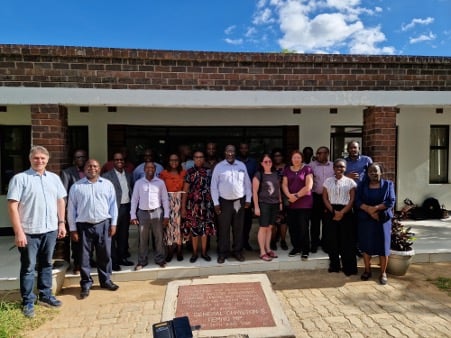
Karelia UAS and Lapland UAS from Finland and Copperbelt University (CBU) and Mulungushi University (MU) from Zambia have collaborated in capacity building of the Zambian universities’ online pedagogic skills. Lecturers from Joensuu and Rovaniemi visited the Zambian universities to hear more about their experiences and use of the skills trained within the collaboration. Two workshops were held, one at CBU and one at MU, where the local lecturers presented their experiences of online teaching.
The project started with workshop held in Zambia in 2023, introducing the basic online pedagogic skills for CBU and MU staff. In spring 2024, teachers from both Mulungushi University and Copperbelt University visited Rovaniemi (see article in Finnish) as guests of Lapland University of Applied Sciences.
During the visit and the workshops in Rovaniemi, they studied online teaching pedagogy and the organization of online courses. The lessons learned from the workshops were used as the basis for preliminary course plans and implementation. They also got to see the learning environments of Lapland University of Applied Sciences and the production of renewable energy in the area.
During our visit now, almost a year later in March 2025, in Zambia we heard directly from the teachers of both Mulungushi and Copperbelt universities about how they had applied the ideas gained in Finland with their own students.
Good experiences about online teaching
The teachers had organized various types of courses. Some have been totally on-line courses, while others have included on-site parts and distance learning parts supported by online activities. The course scope has varied from short courses of several credit points to larger study modules.
The teachers described that online teaching is a very practical method for delivering education—or some parts of it—within the Zambian context. And even if online education has certain challenges, it is nonetheless a promising approach for organizing and diversifying teaching.
In Zambia, even short-distance travel can take a significant amount of time. Online learning eliminates the time previously spent commuting and traveling. Additionally, since students can study remotely and according to their own schedules, many are able to continue working and take care of their families in their hometowns instead of having to spend extended periods in a university city.
Challenges in online studies
Online studies face challenges such as poor internet connectivity and both planned and unplanned power outages. This makes it crucial to design studies in a way that they can be completed entirely on a student’s own schedule—whenever technology permits. On the other hand, live online lectures, where all students are present at the same time were also considered important. Teacher´s opinion was that the students appreciated opportunities for online interaction between self-paced, independent studying. However, all lectures must always be recorded to ensure accessibility for those that are unable to attend online at certain time.
Since a large portion of students study via mobile phones, the courses need to be designed so that both the materials and assignments are accessible on mobile devices. The universities’ limited resources also mean that expensive software or licenses cannot be acquired, so the studies must be based on free tools and apps. These are for example free versions of Moodle and Google tools as well as Padlet and Canvas.
The teachers appreciated easy integration of automated quizzes to courses. These quizzes allow students to check their own learning progress and understanding, which supports the student and helps conserve the teacher’s resources. On the other hand, designing and assessing tasks in subjects like mathematics was seen as more challenging. Teachers expressed a need for more ideas on how to improve formatting and submission of mathematical assignments. The discussion boards and platforms were used to increase interaction and encourage students to share their knowledge and ideas and discuss. Also the discussion boards were used to post and comment reports and tasks –individual or group.
Mindset is key
Overall the teachers were even surprised by the positive response of the online courses. As well as the amount of dialogue and interaction that took place in the online courses. This was seen in the form of active discussions during live lectures and lively exchanges on discussion platforms.
For us, it was truly inspiring to see how online teaching suits the Zambian context. While the environment and infrastructure do pose some challenges, the positive aspects clearly outweigh them. We were delighted to see that the teachers had boldly embraced the development of online education and were facing the challenge with a constructive and developing mindset.
Taking the E-leap – Toolbox for interactive and motivating online courses is a project implemented by Karelia University of Applied Sciences (coordinator), Copperbelt University and Mulungushi University and Lapland University of Applied Sciences. It is funded by the Team Finland Knowledge programme and implemented 2023-2025. The project aimed to increase the pedagogical skills of the staff for providing online courses. It included workshops which introduced the basics of e-learning, for example pedagogical aspects, technical (i.e. learning management software, challenges with bandwidth and complementary applications), planning, execution and evaluation of the courses and hands on course design.
Authors:
Mari Hautala, lecturer in forestry, Karelia University of Applied Sciences
Kaija Saramäki, senior lecturer in energy and environmental engineering, Karelia University of Applied Sciences
Jussi Soppela, principal lecturer in bioeconomy, Lapland University of Applied Sciences