
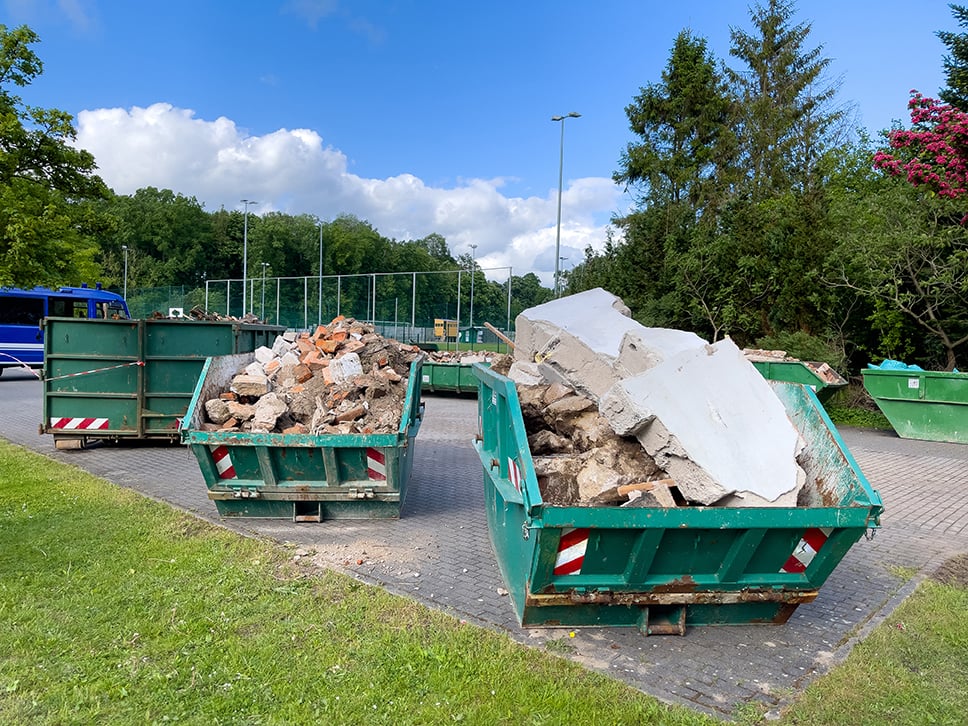
Construction and demolition waste (CDW) accounts for more than a third of all waste generated in the EU (European Commission 2026 b). Although most of the European countries exceed the 70% CDW recovery target set by the EU Waste Framework Directive 2008/98/EC, research shows that the qualitative aspect of this accomplishment requires more careful examination, as a large portion of the recovered CDW is still processed through low-value recycling methods, particularly backfilling, which limits the circularity potential of construction and demolition materials (Kleponė and Kovaitė 2026). Integrated policy approach combining long-term support for innovation with targeted incentives for streamlining Construction and Demolition Waste value chain is needed. In Finland, a system for reporting CDW fractions has been established.
The push for construction waste handling and its implications for the CDW sector
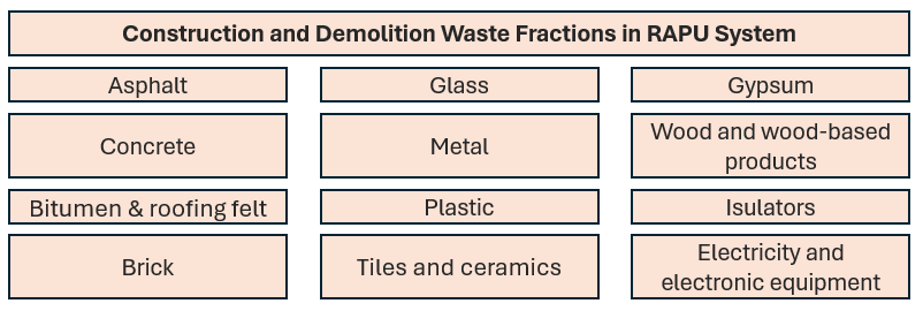
Based on volume, Construction and Demolition (CDW) waste is the largest waste stream in the EU (EU 2018). This is more than a third of all waste generated in the EU and includes among others, concrete, bricks, wood, glass, metals and plastic, ranging between high and low resource value (European Commission 2026 b). CDW is therefore a priority waste stream under the Waste Framework Directive “The EU Waste Framework Directive 2008/98/EC” which entered into force on 12 December 2008 (European Commission 2026 b).
The Directive establishes a binding framework for treating waste in the EU, where waste prevention is inevitable (European Union 2026). It emphasizes among other, the importance of proper waste management, recovery and recycling techniques to reduce pressure on resources and improve their use (European Commission 2026). It also promotes selective demolition to enable the removal and safe handling of hazardous substances, while facilitating re-use and high-quality recycling by selective separation of materials and establishing of sorting systems (European Commission 2026 b). It guides actions and targets recycling of CDW to at least 70%.
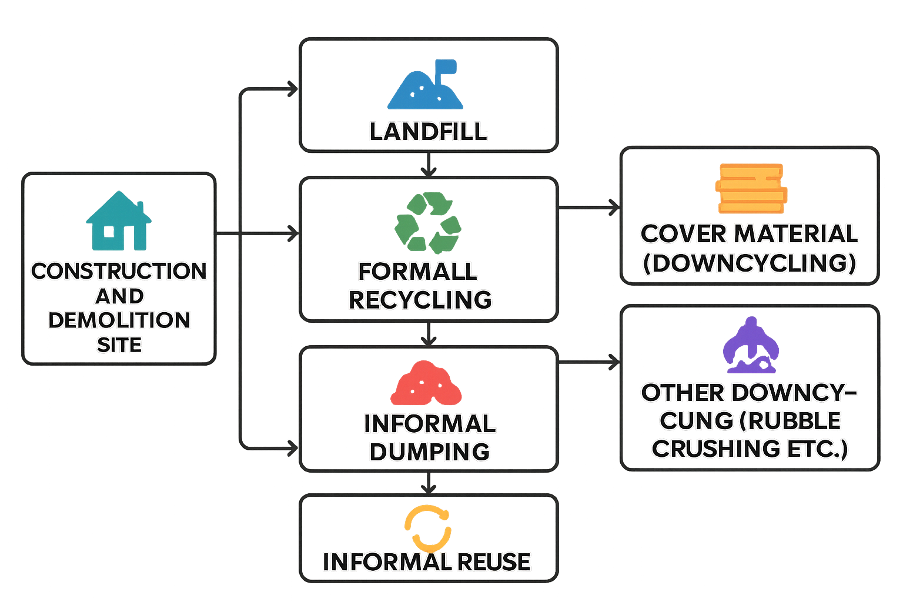
The challenge, however, is that the level of recycling and material recovery of CDW varies greatly across the EU, ranging from less than 10% to over 90% (European Commission 2026 b). In addition, although most of the European countries exceed the 70% CDW recovery target set by the Directive, research shows that the qualitative aspect of this accomplishment requires more careful examination, as a large portion of the recovered CDW is still processed through low-value recycling methods, particularly backfilling, which limits the circularity potential of the materials (Kleponė and Kovaitė 2026).
To accelerate Europe’s CDW recycling and re-use, the European Commission additionally adopted its first Circular Economy Action Plan, listing the construction sector as one of the important sectors under the seven “key product value chains” identified (Silvennoinen and Ruotsalainen 2022). The Action Plan set concrete and ambitious actions, with measures covering the whole life cycle from production and consumption to waste management and the market for secondary raw materials (European Commission 2026).
Despite the efforts to accelerate actions towards “closed loop system”, a considerable disparity remains in the share of construction and demolition waste recycled, ranging from below 50% in countries such as Finland and Norway, to nearly 100% in Italy and the Netherlands (Kleponė and Kovaitė 2026). EU countries also still apply different definitions of CDW, which complicates cross-country comparisons (European Commission 2026). Research, in among other, “Improving the recycling rate of construction and demolition waste in Sweden – A reverse logistics perspective”, proves from its analysed cases, that the impact of CDW is higher and cost generally lower, when on-site sorting is done, compared to when no on-site sorting is done (Manjunath and Umrigar 2017).
The EU Waste Directive sets a target for Finland as well, i.e. 70% of construction and demolition waste must be recovered. In Finland, construction waste is the second largest waste category by volume (Finnish Environment Institute 2026). To address the issue, the Ministry of the Environment issued a decree on the construction and demolition waste handling (Ministry of the Environment 2024). The aim of the decree issued on 30.12.2024, is to create conditions for the recycling and reuse of construction and demolition materials, improve the utilization of soil and aggregates, enhance the statistical monitoring of construction and demolition waste, and strengthen regulatory oversight.
As a result of the decree “Rapu – construction and demolition waste information system” was established for the CDW sector actors and private persons in Finland to report on waste fractions (Finnish Environment Institute 2026b). The system is maintained by the Finnish Environment Institute and started operation on 1st January 2025. The aim is twofold, (i) to develop a system that can better classify CDW fractions to better estimate quantities, and (ii) the information in Rapu system help prepare and update construction and demolition waste report required under Section 16 of Finland’s Construction Act.”
Rapu-System – Who should report what? when? and how?
Even though the Rapu-sytem is still under development, it is already in use and can be accessed via the link https://rapuselvitys.fi/. To gain access to the system, a strong identification to prove one’s identity is needed. Reporting can be made in Finnish, Swedish and English.
Reporting in the system is made when one is either (i) applying for a building or demolition permit, or (ii) when submitting a demolition notification. Making a report is not needed if (i) no new construction is to be carried out, or (ii) the amount of demolition materials is minimal. As a guideline, “minimal amounts” mean 100 square meters of floor area or less in a full demolition project or 10 tonnes or less of demolition material in a renovation project. If the perimeters are over minimal amount, reporting is needed. Depending on the case, the municipal building control authority may require reporting even when these thresholds are not exceeded. For new construction projects that do not include demolition activities, the reporting requirement is limited to an estimate of soils and aggregates transported off-site.
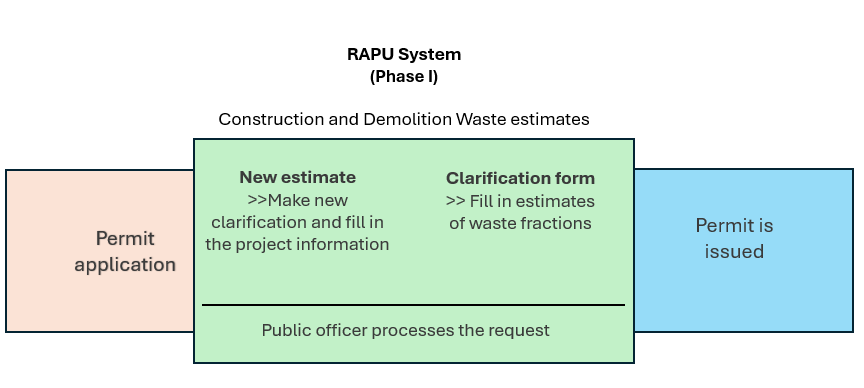
Reporting is made in two phases. Phase one is a preliminary CDW estimate report, meaning an estimate is made of the materials that will be generated from the project. When applying for a permit, the report must include:
demolition materials that will be generated;
materials containing hazardous substances in sites where an asbestos survey is required, i.e. for buildings built before 1994, and;
soil and aggregates that will be transported away from the project site, classified as contaminated and uncontaminated.
Thereafter, phase one is evaluated by the municipal building control authority, after which a permit is issued. This phase is planned to be further developed to enable the reporting of reusable materials and structural components, enabling the transfer of this information to, for example, commercial platforms, with the aim of supporting the development of markets for demolition products and materials.
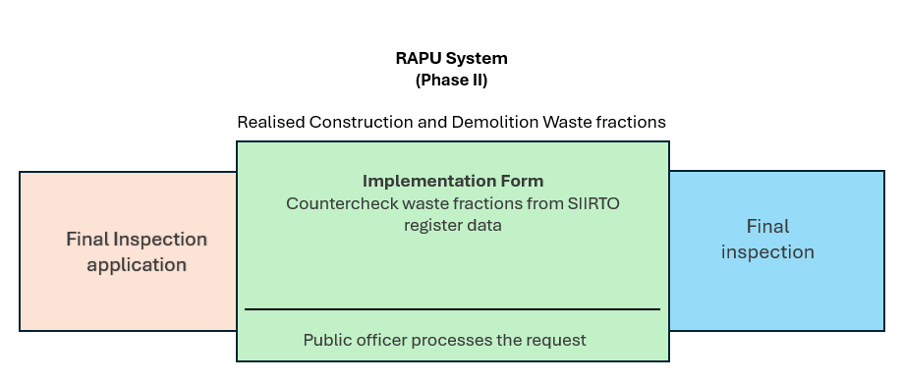
Once the CDW project is completed, the report is updated to include information on the quantities of waste transported off-site, i.e. realized amount (phase II). The data are based on waste transfer documents and are automatically transferred from the national waste transfer register (SIIRTO), integrated within the Rapu system. Imported data can be manually supplemented or corrected.
Karelia University of Applied Sciences (Karelia UAS) Interreg Aurora funded “EU-MAT: Effective Urban Material Mining in Cities project” in collaboration with Finnish Environment Institute (SYKE) jointly organised a workshop in spring 2026 where the Rapu information system was presented to CDW sector actors. The workshop covered the use of the Rapu information system, especially from the perspective of those working with construction and demolition projects. Participants’ feedback on the system’s features and further needs were also gathered, for consideration in Rapu’s further development work by SYKE, and in Karelia UAS’s EU-MAT project development work. The recording can be accessed from https://urn.fi/urn:nbn:fi:oerfi-202604000001761_2 .
Importance of assessing structural weaknesses in the current CDW performance assessment
According to Kleponė and Kovaitė 2026 research, attention to construction and demolition waste (CDW) needs to be directed to the structural weakness in the current performance assessment, where progress is often measured in terms of recovery volume rather than recovery value (Kleponė and Kovaitė 2026).
For example, CDW is still processed through low-value recycling methods, particularly backfilling, which limits the circularity potential of the materials (Kleponė and Kovaitė 2026). Backfilling is using suitable waste for reclamation purposes in excavated areas or for engineering purposes in landscaping and where the waste is a substitute for non-waste materials (Nordic Council of Ministers 2026).
Among other, lack of advanced sorting systems, inconsistent material quality, and inadequate tracking mechanisms are considered key factors limiting effective reuse and recycling (Manjunath and Umrigar 2017). Kleponė and Kovaitė (2026) and Manjunath and Umrigar (2017) propose among other, that CDW recycling shift to integrated policy approach that combine long-term support for innovation with targeted (i) incentives for recycled material use and (ii) streamlined and circular-aligned permitting systems.
The Finnish RAPU system was a reaction to the Ministry of the Environment’s 30.12.2024 issued decree on reporting CDW amounts. However, it does to some extent already combine targeted incentives for streamlining CDW value chain while informing policy. Different fractions of waste are reported, with opportunity to report on re-used fractions. As the developments continue, this system could integrate and test new features to bridge gaps mapped via research. Integrating a feedback form for users to report other fractions not within the main classifications could also help structure CDW waste to better estimate quantities, inform policy, identify use potential for fractions, and map out problematic issues across the value chain needing attention.
The system may, depending on final features integrated, offer learnings that could be adapted also in other countries. For example, information on quantity of materials that could be scaled further e.g. via quality analysis of fractions and estimation of re-use potentials. This may indirectly strengthen policy but also drive new innovations and business models. In addition, awareness about challenges in sorting waste fractions at end-of life (demolition stage), could also inform the construction sector and policy, to streamline practices at start of life (design and construction stage).
EU-MAT – Effective Urban Material Mining in Cities project
EU-MAT: Effective Urban Material Mining in Cities project focuses on promoting circular construction in northern cities, where long distances, sparse populations, and logistical challenges hinder effective material re-use. In the project, we address these challenges by developing material mining methods that can accurately assess the quantity and quality of re-usable materials from demolitions.
By leveraging material flow analysis, spatial modelling and machine learning methods, innovative product development possibilities for recycled materials, and cross‑border expertise between participating countries, the partnership aims to develop methods and solutions adaptable especially to northern sparsely populated cities. Karelia University of Applied Sciences (Finland) is the project’s lead partner, working in collaboration with project partners Aalto University (Finland), RISE Research Institutes of Sweden, and the Arctic University of Norway (UiT).
Authors:
Daisy Silvennoinen, Project coordinator, Karelia University of Applied Sciences
Venla Heiskanen, Project specialist, Karelia University of Applied Sciences
Jouni Luoma, Project Manager, Karelia University of Applied Sciences
Salla Anttila, Information specialist, Karelia University of Applied Sciences
References:
Berge, S., Von Blottnitz, H. (2022). An estimate of construction and demolition waste quantities and composition expected in South Africa. August 2022. South African Journal of Science. DOI:10.17159/sajs.2022/12485. LicenseCC BY 4.0.
European Commission (2018). EU Construction and Demolition Waste Protocol and Guidelines. https://ec.europa.eu/newsroom/growth/items/455097/en .
European Commission (2026). First circular economy action plan. https://environment.ec.europa.eu/topics/circular-economy-topics/first-circular-economy-action-plan_en .
European Commission (2026b). Construction and demolition waste. https://environment.ec.europa.eu/topics/waste-and-recycling/construction-and-demolition-waste_en .
European Union (2026). Summaries of EU Legislation. EU waste management law. https://eur-lex.europa.eu/EN/legal-content/summary/eu-waste-management-law.html?fromSummary=20 .
Finnish Environment Institute (2026). Construction waste. https://www.ymparisto.fi/en/sustainable-circular-and-bioeconomy/waste-and-recycling/national-waste-plan/construction-waste .
Finnish Environment Institute (2026b). Rapu – purkumateriaali- ja rakennusjäteselvitys, in English “Rapu – Demolition material and Construction Waste Clarification”.
Kleponė, D., Kovaitė, K. (2026). What drives high-value construction and demolition waste recycling in the EU? Waste Management Bulletin, Volume 4, Issue 2, 2026,100303, ISSN 2949-7507, https://doi.org/10.1016/j.wmb.2026.100303.
Manjunath, C., Umrigar, F. (2017). Improving the recycling rate of construction and demolition waste in Sweden – A reverse logistics perspective. https://publications.lib.chalmers.se/records/fulltext/254135/254135.pdf .
Ministry of the Environment (2024). Press Release 31.12.2024 10.22. Purkumateriaali- ja rakennusjäteselvitys vahvistaa rakentamisen kiertotaloutta, in English “Demolition Material and Construction Waste Report Strengthens the Circular Economy in Construction”. https://ym.fi/-/purkumateriaali-ja-rakennusjateselvitys-vahvistaa-rakentamisen-kiertotaloutta .
Nordic Council of Ministers (2026). Definitions. https://pub.norden.org/temanord2023-544/definitions.html .
Silvennoinen, D., Ruotsalainen, M.L. (2022). Towards a circular bioeconomy – A comparative analysis of Finland, Norway, Ireland and Scotland. https://urn.fi/URN:ISBN:978-952-275-371-7 .
The ‘EU-MAT: Effective Urban Material Mining in Cities’ project is funded by Interreg Aurora.
Learn more from project website.
