
This article discusses the rationale and necessary preconditions for strengthening research, development and innovation (RDI) activities within universities of applied sciences in Finland. It uses the establishment of the KAFS research community, focused on age-friendliness, as a pilot initiative for developing a more structured and sustainable research group model at Karelia University of Applied Sciences (Karelia UAS). The discussion builds on insights presented in the article in Finnish published in 2026 in AgeNOW! (Kukkonen et al., 2026).
RDI activities at Finnish universities of applied sciences
RDI activities form an established and statutory part of the mission of universities of applied sciences in Finland. According to the Act on Universities of Applied Sciences (932/2014, Section 4), these institutions are responsible for providing higher education oriented toward professional expertise and conducting applied RDI activities. RDI activities are required to support education, promote working life development and regional vitality, and contribute to the renewal of regional economic structures.
The impact of RDI activities is monitored both externally, such as through evaluations by the Finnish Education Evaluation Centre (KARVI), and internally within each institution. The scale of RDI work is significant: for example, Karelia University of Applied Sciences (Karelia UAS) had 47 active projects in 2024, nine of which were international. RDI activities accounted for 19% of the institution’s total person per years (Karelia UAS 2025).
The Ministry of Education and Culture steers universities of applied sciences through a performance-based funding model, in which 20% of basic funding is tied to RDI outcomes (funding model effective since 1 January 2025). This RDI-related share consists of:
• External RDI funding (12% of total funding)
• Completed higher Master’s degrees (6%)
• Publications (2%) (Ministry of Education and Culture 2024.)
As research and development project activities and their support systems have become established as part of the organizations of universities of applied sciences, several universities of applied sciences have reorganized their research and development structures: centers of excellence, research groups, and research units have been founded.
The current development phase of RDI activities is also closely connected to the integration of RDI into education. For example, nationwide work on strengthening higher Master’s degrees in universities of applied sciences has been carried out through the national Master’s degree development initiative (VaKe project, 2024–2025). One of the project’s key aims has been to reinforce the connection between RDI activities and Master’s theses, which are inherently working life-oriented development tasks (Liljander & Kotila 2025, 12). Strengthening this link is expected to support the profiling of Master’s level education in alignment with institutional RDI priorities and, consequently, to advance the development of strong centers of excellence (Kuusisto-Ek 2025, 18).
Transformation in universities of applied sciences
The Roadmap for Higher Education and Research (Ministry of Education and Culture 2017, 6) outlines several major challenges facing higher education institutions: the transformation of work, digitalization, collaborative responses to global challenges, internationalization and networking, openness in learning and research, and increasing global competition for expertise. These societal and global developments raise important strategic questions for universities of applied sciences as they plan their future direction. For instance, what role will universities of applied sciences play in an increasingly international RDI environment and how can Finnish UAS education be further developed to support strong working life-oriented expertise, innovation capabilities, research-based development, and applied research?
The most recent development in the educational mission of Finnish universities of applied sciences is the national discussion concerning the introduction of professional doctoral degrees. Twelve universities of applied sciences have jointly prepared a proposal to integrate such degrees into the Finnish higher education system. According to the 2025 proposal, professional doctoral education is intended to respond to the evolving development needs of working life and to strengthen regional vitality. The participating institutions have recommended launching a national pilot during the next government term (Professional doctoral education, 2025).
Universities of applied sciences occupy a distinctive position in the Finnish higher education landscape. They are simultaneously regional development actors and methodological experts in applied RDI activities, which gives them a unique role in responding to these emerging challenges.
Developing the research community on age-friendliness
One of the strategic priorities of Karelia University of Applied Sciences for 2020–2030 is sustainable wellbeing. Within this framework, one key objective has been to strengthen RDI activities related to age-friendliness and to establish the KAFS research community (Karelia research community on age-friendliness). Age-friendliness has been a strategic and regional development focus at Karelia UAS for fifteen years, shaped by both the demographic trajectory of North Karelia and global population ageing. Work in this area has been carried out through education and RDI activities, and the KAFS research community now brings together all development efforts related to ageing.
The Ministry of Education and Culture supported Karelia UAS’s profiling in age-friendliness during 2020–2023. The EAFS project (RDI Excellence in Creating an Age-friendly Society in Remote Areas) aimed to develop a community of practice (CoP) model for age-friendliness, drawing on the work of Wenger (2011; 1998) and Engeström (1987). The CoP model was piloted and evaluated across multiple networks and contexts during the project. Key insights from this methodological development included the value of multistakeholder and dialogical collaboration, the strengthening of co-development and networking, and the generation of concrete RDI ideas. These practices enabled regional, national, and cross sectoral cooperation that advances age-friendliness.
The development and piloting of the CoP model provided the foundation for the KAFS research community structure established in autumn 2025. The need to reinforce the research community and to integrate RDI and education aligns with national developments aimed at strengthening RDI activities within universities of applied sciences. At Karelia UAS, the importance of a dedicated research community focused on age-friendliness has become increasingly evident through earlier research and development projects, as well as through regional, national, and international networking and project collaboration.
It is also essential to make the systematic and established structure of RDI activities related to age-friendliness, and their integration into education, visible. Rather than presenting isolated projects, Karelia UAS seeks to articulate a strategic, goal-oriented whole that supports continuity, the accumulation of results, and their effective use in educational activities and continuous learning services.
The structure of the KAFS research community was developed in autumn 2025 in collaboration with principal lecturers and teachers involved in the Master’s degree programme in Active Ageing. Karelia UAS is a partner in the INVEST Alliance, funded through the Erasmus+ European Universities initiative, which aims—among other objectives—to establish a joint research structure to support RDI activities (Kukkonen 2025). The launch of the KAFS research community has been supported by this alliance.
In defining the structure of KAFS, attention was given to earlier development work, including insights gained from the methodological development of the community of practice (CoP) on age-friendliness. Benchmarking was also conducted with similar research communities and clusters at other universities of applied sciences. For example, the activities and thematic structure of GerHos, a joint gerontological care and rehabilitation competence cluster of Lapland UAS, Oulu UAS, and the University of Oulu, served as inspiration for shaping the structure of the KAFS research community.
The objectives and structure of the KAFS research community
The tasks of the KAFS research community focus on RDI activities related to age-friendliness, its role as a think tank for age-friendly development, social impact, and participation in national and international research and innovation networks. The community also collaborates with the national UAS network for age-friendliness, IOVE, and engages in project planning, networking, working life cooperation, and coordination of education–RDI integration on age-friendliness. In addition, KAFS functions as an RDI learning environment for students in the Master’s Degree Programme in Active Ageing and the Bachelor’s Degree Programme in Applied Gerontology.
The objectives of KAFS are divided into qualitative and quantitative goals. Qualitative objectives include strengthening RDI cooperation with universities and the welfare sector, promoting multidisciplinary and cross sectoral collaboration, and maintaining and developing the vitality of the research community. Quantitative objectives relate to participation in project preparation, the number of Master’s and Bachelor’s theses, and the production of various types of publications.
The activities of the KAFS research community are built around a team of teachers from the Master’s in Active Ageing programme, including lecturers from the social and health care fields. The community also enables dissertation supervision and supports the studies of doctoral students. Its membership includes Karelia UAS’s senior project manager, heads of education, and experts from RDI support services. This structure facilitates closer regional and national cooperation with working life partners. The tasks defined for the community strengthen RDI collaboration with actors in the field of wellbeing and beyond.
In terms of content, the development of age-friendliness is guided by the focus areas for promoting age-friendliness (Figure 1), updated by KAFS.
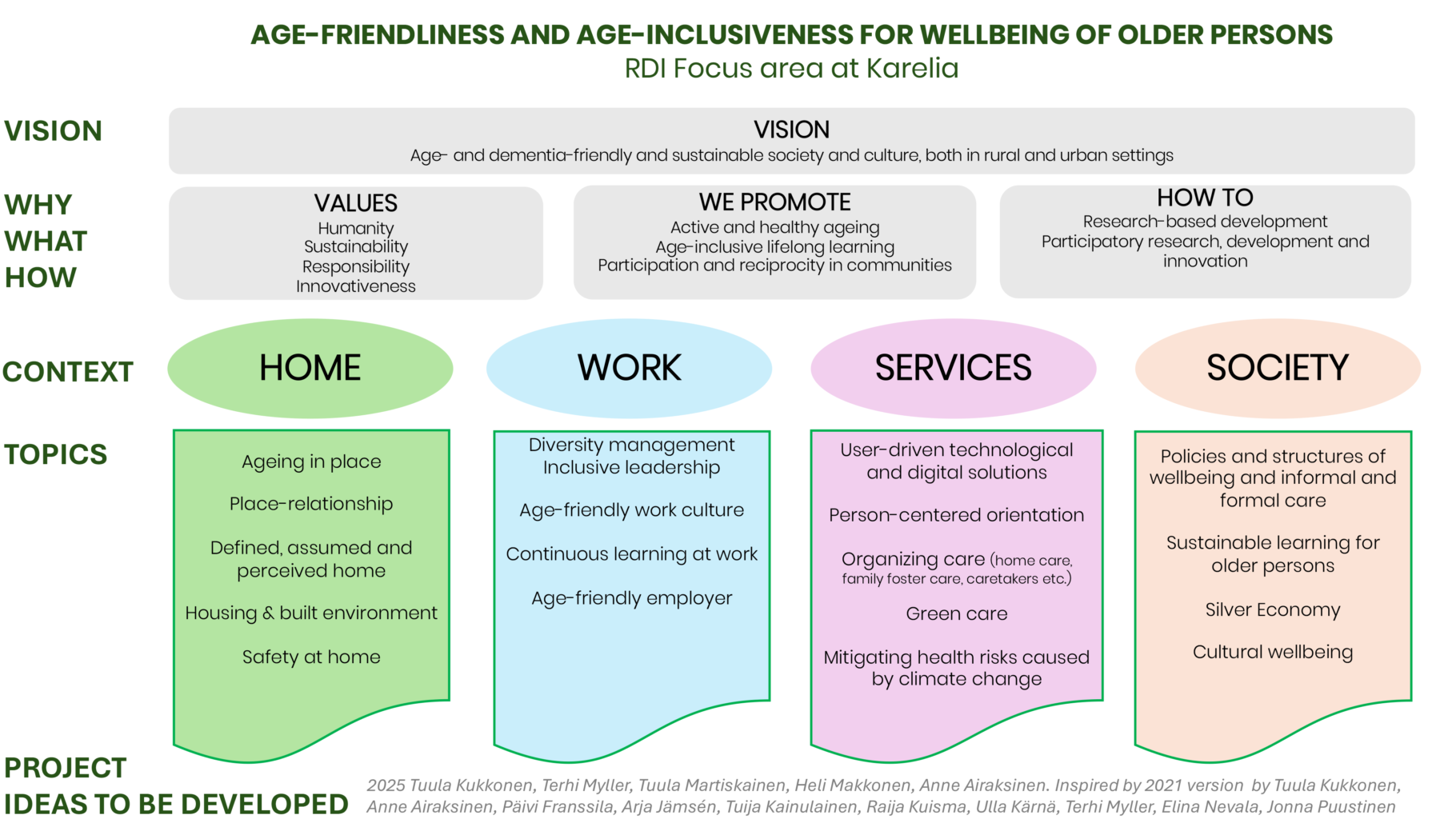
These focus areas build on the model developed during the EAFS project and have been refined by structuring development work according to specific contexts. The research community’s vision, an age- and memory-friendly, sustainable society and culture in both rural and urban environments, defines the purpose of its activities. The focus areas are examined across four contexts: the home environment, working life, services, and society at large. For each context, KAFS has identified thematic areas that are considered essential to promote.
Our vision is an age-friendly, memory-friendly, and sustainable society and culture in both rural and urban environments. In addition to promoting age-friendliness, we also aim to develop memory-friendliness, and our research community seeks to contribute to sustainable development. Areas for developing age-friendliness are examined in different contexts: at home, in working life, within services, and more broadly across society as a whole. For each context, we have identified specific themes that we aim to advance.
The KAFS research community works!
The KAFS research community for age-friendliness is the model developed by teachers specializing in age-friendliness. All developers within the KAFS research community have extensive experience in delivering education and development projects in the field of ageing. As a result, the integration solutions required for RDI and education activities have become embedded in the research community’s model. The KAFS research community brings together development projects and educational activities in age-friendliness and strengthens dialogue and collaboration among teachers and networks working in this field.
The research community’s model was presented to the management team of Karelia UAS in February 2026. We received encouragement to continue and further develop the research community’s activities. This feedback is highly meaningful for the members of the research community: the development work carried out by teachers is valued.
The KAFS research community is a small part of the broader movement to develop age-friendliness. The development work carried out in the EAFS project has now been utilized in advancing the research community’s work. The next challenge is to establish a permanent base for the research community’s activities. In this, we can draw on our experiences in implementing the CoP model. Network collaboration, like genuine RDI activities, is long-term work. In addition to experts in age-friendliness, research and development, and education, the research community requires close cooperation with RDI services and those responsible for education.
Making RDI activities in age-friendliness visible, which is one of the research community’s key tasks, requires integrating communication into the research community’s operations. The development of the research community’s website has been identified as an important measure for further improvement.
Authors:
Kukkonen, Tuula, principal lecturer, Karelia University of Applied Sciences
Myller, Terhi, principal lecturer, Karelia University of Applied Sciences
Makkonen, Heli, principal lecturer, Karelia University of Applied Sciences
Martiskainen, Tuula, principal lecturer, Karelia University of Applied Sciences
AI–assisted tools have been used in producing this text for translation and language improvement.
References
Ammatillinen tohtorikoulutus. 12 ammattikorkeakoulun ehdotus. https://www.ammatillinentohtoritutkinto.fi/wp-content/uploads/sites/2/2025/11/Ammatillinen-tohtorikoulutus_WEB.pdf
Ammattikorkeakoululaki 932/2014.
Engeström, Y. 1987. Learning by Expanding: An activity theoretical approach to developmental research. Helsinki: Orienta konsultit.
Karelia ammattikorkeakoulu. 2025. Toimintakertomus. https://www.karelia.fi/toimintakertomus-2024/#tki
Kukkonen, T. 2025. Karelian ikäosaaminen mukaan kansainväliseen tutkimusyhteistyöhön. Pulssi-verkkojulkaisu 14.3.2025. Karelia-ammattikorkeakoulu. https://www.karelia.fi/2025/03/karelian-ikaosaaminen-mukaan-kansainvaliseen-tutkimusyhteistyohon/
Kukkonen, T. 2023. Yhteiskehittämisellä kohti osaamisyhteisön toimintamallia. IkäNYT! – Ikäosaamisen verkkojulkaisu 2/2023. Karelia-ammattikorkeakoulu. https://ikanyt.karelia.fi/2024/05/20/yhteiskehittamisella-kohti-osaamisyhteison-toimintamallia/
Kukkonen, T., Makkonen, H., Airaksinen, A., Hyppönen, E., Lappalainen, M. & Myller, T. 2023. Ikäystävällisyyden vahvistaminen strategisena kehittämiskohteena. IkäNYT! – Ikäosaamisen verkkojulkaisu 2/2023. Karelia-ammattikorkeakoulu. https://ikanyt.karelia.fi/2024/05/20/ikaystavallisyyden-vahvistaminen-strategisena-kehittamiskohteena/
Kuusisto-Ek, H. 2025. YAMK-tutkintojen merkitys ammattikorkeakoulujen profiloinnissa. Teoksessa Aura, P., Mäki, K., Heikkanen, S., Kotila, H. & Hero, L-M. (toim.) 2025. Vaikuttava YAMK. Haaga-Helian julkaisut D6. Haaga-Helia ammattikorkeakoulu, 15–19. https://www.theseus.fi/bitstream/handle/10024/903804/vaikuttavayamk.pdf?sequence=1&isAllowed=y
Liljander, J-P. & Kotila, H. 2025. Kohti koordinoitua ja jatkuvaa ylemmän ammatillisen osaamisen edistämistä. Teoksessa Aura, P., Mäki, K., Heikkanen, S., Kotila, H. & Hero, L-M. (toim.) 2025. Vaikuttava YAMK. Haaga-Helian julkaisut D6. Haaga-Helia ammattikorkeakoulu, 8–14. https://www.theseus.fi/bitstream/handle/10024/903804/vaikuttavayamk.pdf?sequence=1&isAllowed=y
Myller, T. & Puustinen, J. 2022. Ikäystävällisyys: näkökulmia Karelia-ammattikorkeakoulusta ja harvaan asutuilta alueilta. Gerontologia 3/2022. https://journal.fi/gerontologia/article/view/121309/72427
Myller, T. 2023. Ikäystävällinen maaseutu -osaamisyhteisön pilotointi. IkäNYT! – Ikäosaamisen verkkojulkaisu 2/2023.
Karelia-ammattikorkeakoulu. Ikäystävällinen elinympäristö osaamisyhteisön pilotointi – IkäNYT!
Opetus- ja kulttuuriministeriö. 2024. Ammattikorkeakoulujen ja yliopistojen rahoitusmallit vuodesta 2025 alkaen. https://okm.fi/documents/1410845/4392480/Ammattikorkeakoulujen+ja+yliopistojen+rahoitusmallit.pdf/2475ffd6-c8fd-7389-5826-609c4ce10d6f/Ammattikorkeakoulujen+ja+yliopistojen+rahoitusmallit.pdf?t=1712829018346
Opetus- ja kulttuuriministeriö. 2017. Korkeakoulutus ja tutkimus 2030-luvulle. Vision tiekartta. https://okm.fi/documents/1410845/12021888/Korkeakoulutus+ja+tutkimus+2030-luvulle+VISION+TIEKARTTA_V2.pdf
Vähäsantanen, K., Civil, T., Hero, L-M. & Tammilehto, M.T. 2025. Opetukseen kytketty TKI-toiminta: Pilviä horisontissa, ratkaisuehdotuksia näkyvissä. Tiedepolitiikka 1/2025. https://journal.fi/tiedepolitiikka/article/view/154711/103881
Wenger, E. 2011. Communities of practice: A brief introduction. University of Oregon, Scholar’s Bank. https://scholarsbank.uoregon.edu/xmlui/bitstream/handle/1794/11736/A%20brief%20introduction%20to%20CoP.pdf?sequence=1&isAllowed=y
Wenger, E. 1998. Communities of Practice. Learning, Meaning and Identity. Cambridge University Press.